

Guest Blog Post from Matthias Werner, CRM and RevOPs Specialist – September 2026
Most professional sports clubs segment their fans by what they buy, how old they are, or how often they open an email. These methods are useful. But they overlook the richest behavioral data source that every club already owns.
Every matchday, every ticket sold, every renewal generates a precise, timestamped record of how fans choose to support their team. This data is often more valuable for understanding fans than any demographic profile or engagement metric. Yet for most clubs, it lives in the ticketing system and never reaches the CRM or the people who make communication decisions.
Ticket Data as the CRM and CDP Foundation
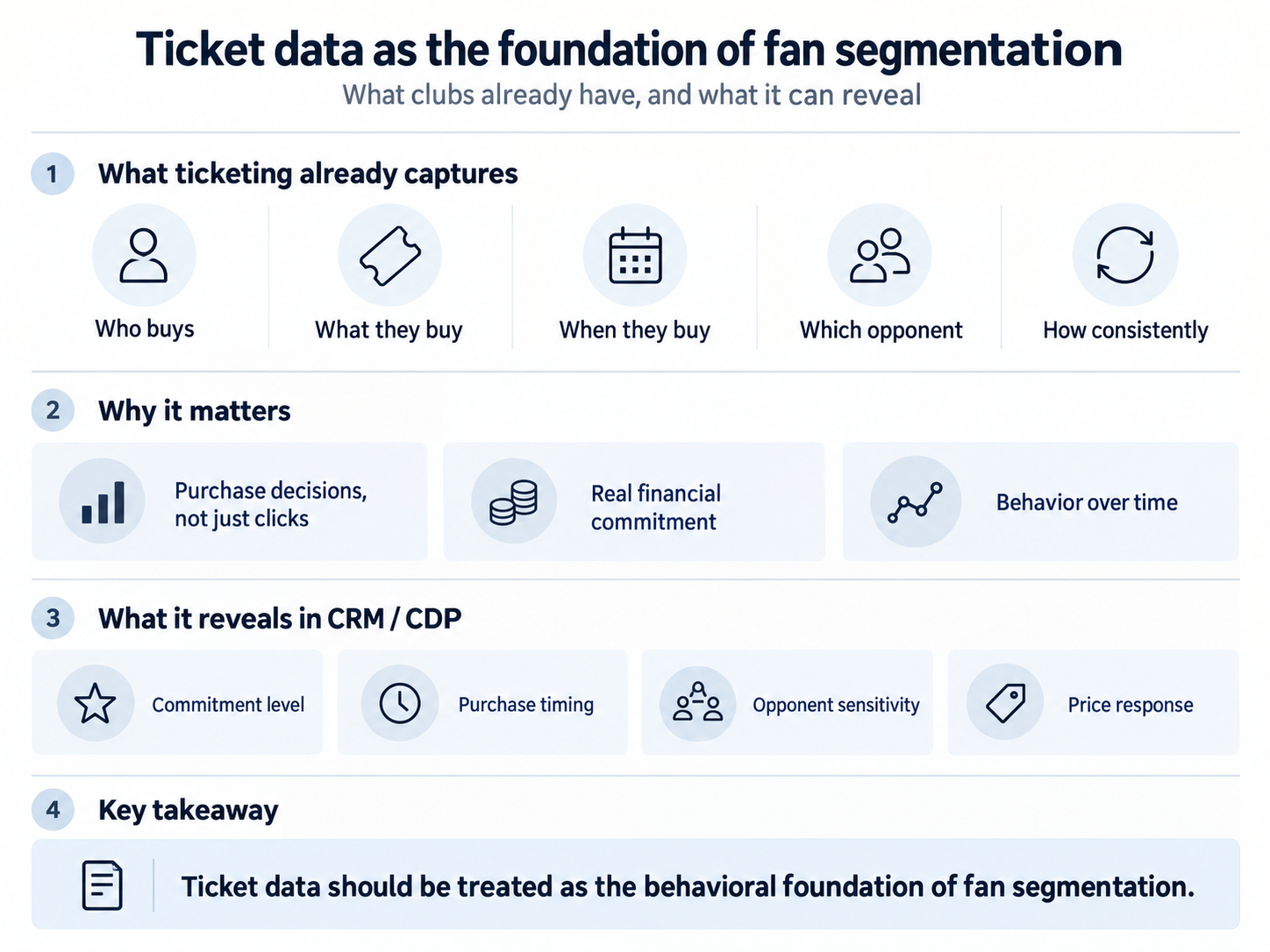
Before layering in social-media signals, email-open rates, or website analytics, the most reliable behavioral data a club has is its ticketing system. It captures what matters most: real purchase decisions.
- Who buys — season ticket, flexible pass, individual match.
- What — category, price tier, add-ons.
- When — how early, in which sales window, at what price.
- For which opponent — home, away, big rivals, friendlies.
- How consistently — renewal behavior over seasons.
These are not only intentions or clicks but financial commitments. A fan who buys a €400 season ticket in July is demonstrating something fundamentally different from one who buys a €30 single for a top-of-the-table match. Both may be registered in the CRM as “active fans.” Both might open the same newsletter. But their relationship with the club is entirely different.
The Value of Ticket-Purchase Segmentation
Once ticket data flows into a CRM or CDP, clubs can segment fans along dimensions that actual purchases reveal:
Commitment level distinguishes the loyal buyer from the occasional visitor. Season-ticket holders who renew regardless of fixture list behavior form a fundamentally different segment from fans who attend only marquee matches. German professional football research confirmed this at the behavioral level: season and free-ticket holders show significantly higher no-show rates than paying day-ticket buyers — because their economic commitment is fixed in advance. [1]
Purchase timing reveals planning behavior. Early buyers tend to be more engaged and have higher lifetime value. Late buyers may respond to different communication triggers entirely. AFC Ajax used machine learning on CRM data to cluster supporters into distinct value-based segments, with purchase timing as a major differentiator. [2]
Opponent sensitivity shows which fans are driven by sporting interest and which by social or habitual behavior. Clubs can identify fans who consistently travel for away matches against big clubs but skip midweek friendlies. This is not captured by age, postcode, or email behavior.
The Missing Dimension: Reactions to Price
All of this comes from ticket purchase data alone. But there is a next level of insight that becomes available once clubs look at how the same fans behave across different price points.
When a club changes a ticket price, whether during a new season, for a specific match category, or as part of a promotional window, fans respond in three distinct ways:
Price-insensitive buyers purchase regardless of cost. These are typically the most highly identified fans, for whom attending the match is non-negotiable. Wittenborg University research found that team identification explained a significant share of purchase intentions, effectively neutralizing pricing friction. [3]
Price-sensitive buyers respond to cost changes. They delay purchases, wait for early-bird windows, or adjust which matches they attend based on value. This is not disloyalty — it is rational economic behavior from fans who want to support their club within their constraints.
Occasional visitors sit in between. Their attendance correlates strongly with opponent attractiveness and match timing rather than price alone. [1]
These patterns are invisible without ticket-to-CRM integration. A CRM that only sees email engagement cannot tell whether a fan bought at full price, waited for a discount, or skipped the match because the price felt too high.
Why the Integration Gap Matters
The data exists in almost every club. The question is where it lives and who can use it.
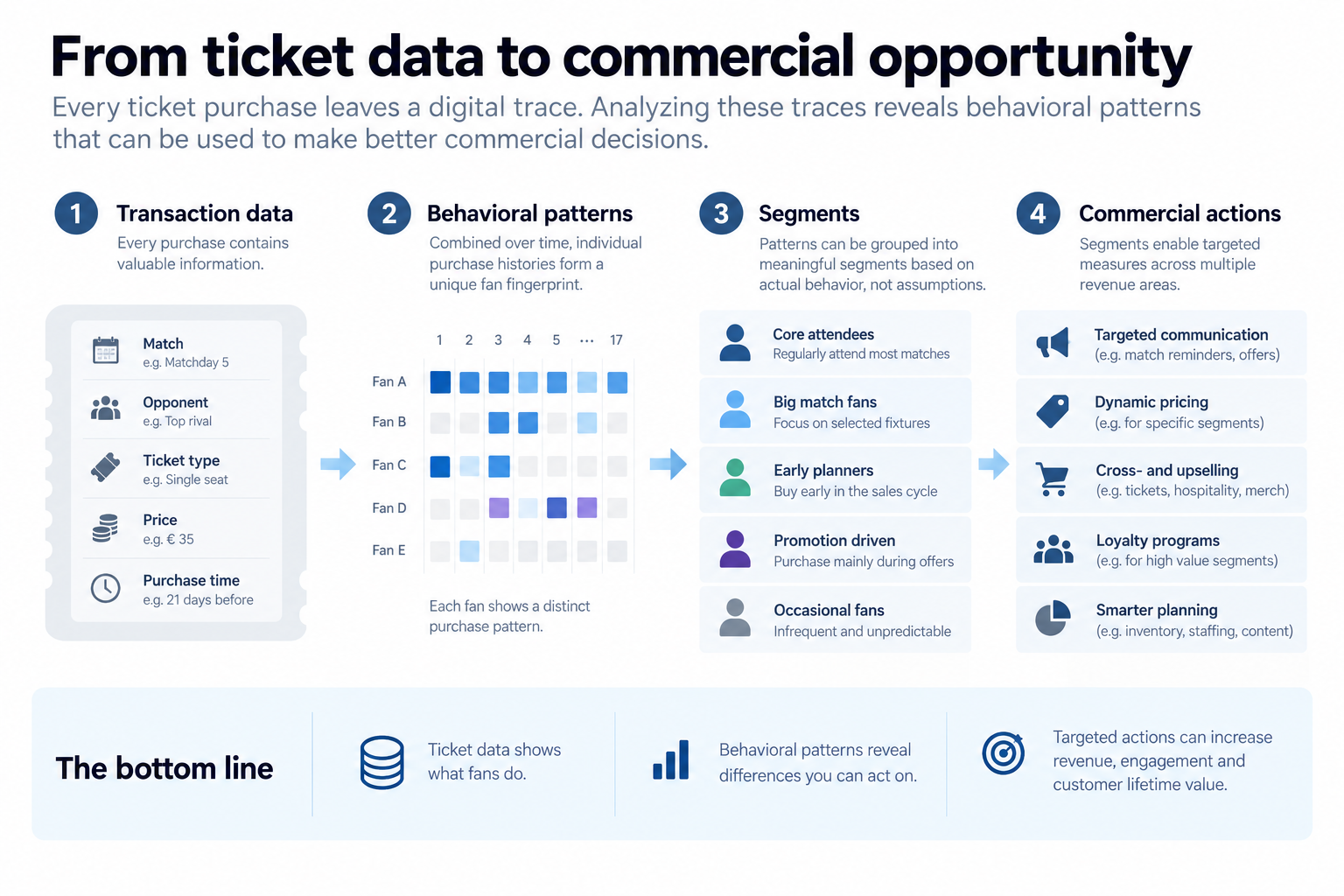
Ticketing platforms typically operate in isolation. CRM systems segment fans without access to transaction-level purchase behavior. Customer data platforms import social and email signals but not from the point of sale itself. This means marketing teams are making segmentation decisions based on behavioral proxies rather than the actual purchase data that would reveal the real segments.
The integration path does not require new data collection or surveys. Ticketing systems already record timestamps, prices, categories, and channels. A simple price-response score — how quickly a fan buys after a price change, whether they wait for promotions, how their attendance tracks opponent strength — can be attached to any existing fan profile.
When clubs understand their fan segments through the lens of real purchase data, communication becomes more targeted. The same message sent to a price-insensitive season-ticket holder and a price-sensitive occasional attendee is not just inefficient, it actively teaches the loyal buyer to wait for discounts they never needed.
The Takeaway
Every professional club already has the data. The question is whether ticketing data gets treated as a transaction ledger or as the behavioral foundation that every fan segmentation strategy should start with. Once that connection is made, understanding how different fan segments respond to price becomes the natural next step. The clubs that treat ticket data as their CRM foundation will reach fans more effectively, without compromising the pricing integrity they have built.
Jeder professionelle Verein verfügt bereits über diese Daten. Die entscheidende Frage ist, ob Ticketdaten lediglich als Transaktionshistorie betrachtet werden oder als Verhaltensfundament, auf dem jede Fansegmentierung aufbauen sollte.
Ist diese Verbindung erst einmal hergestellt, ist der nächste logische Schritt zu verstehen, wie unterschiedliche Fansegmente auf Preise reagieren. Vereine, die Ticketdaten zum Fundament ihres CRM machen, können Fans gezielter ansprechen, ohne dabei die Integrität ihrer Preisstrategie zu gefährden.
Sources
- Smart Pricer No-Show behavioral study in German professional football — https://www.smart-pricer.com/de/einwurf-aus-der-wissenschaft-was-wissen-wir-ueber-no-show-verhalten-im-profifussball/
- AFC Ajax CRM fan segmentation study (unsupervised machine learning clustering) — https://pmc.ncbi.nlm.nih.gov/articles/PMC11378343/
- Wittenborg University fan pricing study (Pahwa, Georgievski, Kaper) — Advances in Consumer Research, 2025 — https://www.wittenborg.eu/how-football-ticket-pricing-shapes-fan-emotion-and-purchase-behaviour.html

Zum Autor
Matthias Werner helps professional football clubs make better use of the fan data they already have.
His work focuses on CRM, marketing automation and data integration, with the goal of turning disconnected systems and transaction data into usable fan profiles, smarter segmentation and measurable commercial impact.
Before starting High Block, Matthias spent several years at a B2B data integration software company, working across finance, analytics and revenue operations and building the systems and processes behind a growing technology business.
Matthias regularly shares practical insights on fan data, CRM and commercial operations in professional sport on LinkedIn. You can follow him there or learn more about his work at highblock.pro.