Berlin – November 2025
Dynamic pricing is one of the most discussed topics in ticketing. Few other pricing models have polarised opinions so strongly: For some, it’s an indispensable tool for increasing revenue and improving capacity utilisation, while for others it’s a symbol of opaque price gouging. But what’s really behind it?
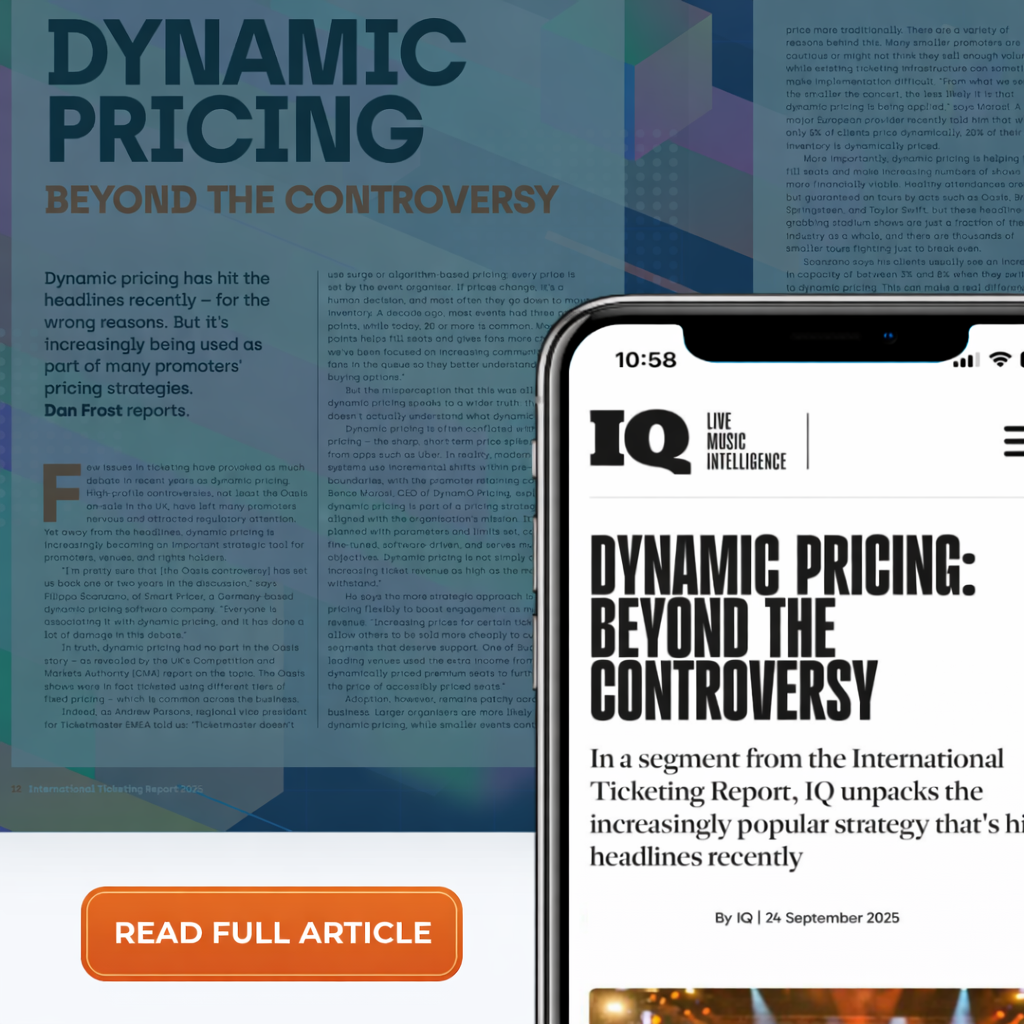
The latest International Ticketing Report from IQ dispels misconceptions and shows that dynamic pricing is more than just short-term revenue maximisation.
MISUNDERSTANDINGS ABOUT DYNAMIC PRICING
In recent months, high-profile ticketing controversies – such as the Oasis case in the UK – have made headlines. Dynamic pricing was prematurely blamed, even though it was not involved.
“The Oasis controversy has certainly set us back one or two years in the public discussion,” explains Filippo Scanzano, Country Manager DACH at Smart Pricer. “Many people automatically associate such cases with dynamic pricing – and that damages the topic.”
In fact, the UK Competition and Markets Authority (CMA) investigation found that Oasis tickets were not dynamically priced but were sold in fixed, highly differentiated price categories. This misunderstanding underscores the extent of the confusion surrounding the issue.
WHAT DYNAMIC PRICING IS – AND WHAT IT ISN’T
Dynamic pricing is often confused with surge pricing. However, there is a clear difference:
- Surge pricing: Prices spike rapidly when demand explodes (e.g., Uber on rainy evenings).
- Dynamic pricing: Prices rise or fall in a controlled manner and within clearly defined limits set by the event organiser.
Specifically, this means:
- Premium seats can become more expensive to reflect high demand.
- Less popular tickets can be priced lower to increase access to live experiences.
This creates a balance between revenue growth and accessibility. Those who book early often benefit from lower prices, while those who book later pay more for this flexibility – similar to airline tickets.
BENEFITS FOR ORGANIZERS AND FANS
When implemented correctly, dynamic pricing creates added value for all involved:
#1 Higher occupancy & revenue:
Smart Pricer customers increase their capacity by an average of 3–8%. This can be crucial, especially for smaller and medium-sized tours with tight margins. With high occupancy, ticket revenue can increase by 5–15%.
#2 Planning security:
Early bird pricing secures revenue early and simplifies the planning of staff, security, and catering.
#3 Fairness for fans:
Revenue from premium seats can be used to offer lower-priced tickets to price-sensitive target groups. For example, a leading venue in Budapest used this method to specifically lower the prices of cheaper seats.
WHY IT IS NOT (YET) USED EVERYWHERE
Despite the advantages, many event organisers are hesitant to implement dynamic pricing. The main reasons are:
- Costs & Resources: For a long time, implementation was complex and expensive, which is why primarily large players were the pioneers. One ticketing provider reported that only 5% of its customers use dynamic pricing, but 20% of its inventory is affected.
- Communication: The most important success factor is transparency. If price adjustments are not explained, fans quickly feel unfairly treated.
“Customers accept flexible pricing – as long as you honestly explain how it’s determined,” says Liv Nilssen, VP / Director of Sector Strategy at Spektrix.
CONCLUSION: THE FUTURE OF TICKETING IS DYNAMIC
The key will be how well event organisers communicate. Whether fans accept a pricing strategy depends less on the numbers themselves and more on whether they can understand how prices are determined.
“These projects succeed or fail based on communication,” says Filippo Scanzano. “If you explain things openly, fans don’t feel exploited – even if they might not like the price.”
Would you like to learn more about the opportunities dynamic pricing offers for your events?
Contact us for a free initial consultation and discover your revenue potential.